

What is the internal structure of Carbon Molecular Sieve - JXF observed by electron microscopy?
As a trusted supplier of Carbon Molecular Sieve - JXF, I've had the privilege of delving deep into the fascinating world of these remarkable materials. Electron microscopy has emerged as an invaluable tool in our quest to understand the internal structure of Carbon Molecular Sieve - JXF, providing us with insights that were once beyond our reach.
The Significance of Understanding Internal Structure
Carbon Molecular Sieves (CMS) are porous carbon materials with a unique structure that enables them to selectively adsorb different gases based on their molecular size and shape. This property makes them indispensable in a wide range of industrial applications, including gas separation processes such as nitrogen generation from air. The performance of a CMS is directly related to its internal structure, which determines its adsorption capacity, selectivity, and kinetics. Therefore, a detailed understanding of the internal structure of Carbon Molecular Sieve - JXF is crucial for optimizing its performance and developing new and improved products.
Electron Microscopy: A Window into the Nanoscale
Electron microscopy is a powerful imaging technique that uses a beam of electrons instead of light to visualize the structure of materials at the nanoscale. There are two main types of electron microscopes commonly used in materials science: scanning electron microscopy (SEM) and transmission electron microscopy (TEM).
SEM provides high - resolution images of the surface topography of a sample. By scanning the surface of the Carbon Molecular Sieve - JXF with a focused electron beam and detecting the secondary electrons emitted from the sample, we can obtain detailed information about the external morphology of the particles. This includes features such as particle size, shape, and surface roughness, which can have a significant impact on the handling and performance of the CMS.
TEM, on the other hand, allows us to look inside the material. A thin section of the Carbon Molecular Sieve - JXF is prepared, and a beam of electrons is transmitted through the sample. The interaction of the electrons with the atoms in the sample produces an image that reveals the internal structure at the atomic or near - atomic scale. This is particularly useful for studying the pore structure of the CMS, which is a key factor in its gas separation performance.
Observations of Carbon Molecular Sieve - JXF by Electron Microscopy
When we observe Carbon Molecular Sieve - JXF using SEM, we typically see a collection of irregularly shaped particles. The particle size can vary depending on the manufacturing process, but generally, they range from a few micrometers to tens of micrometers. The surface of the particles appears rough, with many small protrusions and cavities. These surface features increase the surface area available for gas adsorption, which is beneficial for the performance of the CMS.
Under TEM, the internal structure of Carbon Molecular Sieve - JXF becomes more apparent. The most striking feature is the presence of a network of pores with different sizes and shapes. These pores can be classified into three main categories based on their size: micropores (less than 2 nm in diameter), mesopores (2 - 50 nm in diameter), and macropores (greater than 50 nm in diameter).
Micropores are the most important for gas separation applications because they provide the selective adsorption sites for different gas molecules. The size and shape of the micropores determine which gas molecules can enter and be adsorbed, while excluding others. For example, in nitrogen generation from air, the micropores in Carbon Molecular Sieve - JXF are designed to preferentially adsorb oxygen molecules, allowing nitrogen to pass through and be collected as a product.
Mesopores act as transport channels, facilitating the diffusion of gas molecules from the external surface of the particle to the micropores. They help to improve the adsorption kinetics of the CMS by reducing the diffusion resistance. Macropores, on the other hand, provide a macroscopic pathway for gas flow within the material, which is important for the overall mass transfer of gases in the separation process.
Impact on Product Performance
The unique internal structure of Carbon Molecular Sieve - JXF observed by electron microscopy has a direct impact on its performance in gas separation applications. The high surface area provided by the micropores and the rough surface of the particles results in a high adsorption capacity for the target gases. The well - defined pore size distribution, with a proper balance between micropores, mesopores, and macropores, ensures both high selectivity and fast adsorption kinetics.

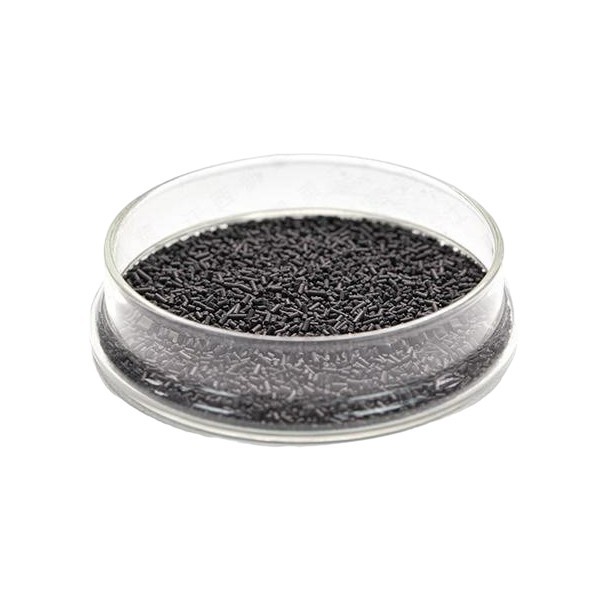
For example, our Carbon Molecular Sieve - JXSEP®HG - 110ES is designed with an optimized internal structure to provide excellent performance in nitrogen generation. The carefully controlled micropore size allows for efficient separation of oxygen from nitrogen, while the mesopores and macropores ensure rapid gas diffusion, resulting in high - purity nitrogen production at a high flow rate.
Similarly, our Carbon Molecular Sieve - JXSEP®LG - 560 is tailored for specific industrial applications where different gas separation requirements exist. By adjusting the internal structure during the manufacturing process, we can optimize the performance of the CMS for different gas mixtures and operating conditions.
Development of New Products
The insights gained from electron microscopy observations also play a crucial role in the development of new Carbon Molecular Sieve - JXF products. By understanding how the internal structure affects the performance of the CMS, we can design and synthesize new materials with improved properties.
For instance, we can modify the manufacturing process to control the pore size distribution more precisely, creating a CMS with a narrower range of micropore sizes for enhanced selectivity. We can also introduce new additives or surface treatments to modify the surface chemistry of the particles, which can further improve the adsorption capacity and selectivity of the CMS.
Our JXSEP HG - 90 Carbon Molecular Sieve is an example of a product that has been developed based on the latest understanding of the internal structure of Carbon Molecular Sieve - JXF. Through continuous research and development, we have been able to optimize its internal structure to meet the evolving needs of our customers in various industries.
Contact for Procurement
If you are interested in learning more about our Carbon Molecular Sieve - JXF products or would like to discuss your specific gas separation requirements, we invite you to contact us for a detailed procurement discussion. Our team of experts is ready to provide you with the best solutions tailored to your needs.
References
- Yang, R. T. (1987). Gas Separation by Adsorption Processes. Butterworth Publishers.
- Thommes, M., Kaneko, K., Neimark, A. V., Olivier, J. P., Rodriguez - Reinoso, F., Rouquerol, J., & Sing, K. S. W. (2015). Physisorption of gases, with special reference to the evaluation of surface area and pore size distribution (IUPAC Technical Report). Pure and Applied Chemistry, 87(9 - 10), 1051 - 1069.
- Lowell, S., Shields, J. E., Thomas, M. A., & Thommes, M. (2004). Characterization of Porous Solids and Powders: Surface Area, Pore Size and Density. Springer.